

The Impact of Visualising Muscle Activation. Regardless of the sport or discipline, more and more coaches and physiotherapists are incorporating EMG-supported analyses and EMG biofeedback training into their daily work with elite athletes. The following article summarizes the lasting impact that the visualisation of muscle activation has on athletes and coaches, illustrating why for instance NBA physiotherapist Simon Iden states: “EMG is a very simple method to check where an athlete stands and where they need to go.”

Tried-and-True Concepts implemented in a modern way
A lot has changed in competitive sports: technology and science are increasingly entering areas that were once guided solely by experience and intuition. Electromyography (EMG) is one of those innovations that can enhance daily training routines. The goal is not to discard traditional methods but rather to supplement them with precise data. EMG allows one to see “how hard” which muscles are working and thus provides an objective basis to create training plans that are even more targeted. Coaches and physiotherapists can integrate EMG mapping and EMG biofeedback training into existing concepts, making proven methods even more effective.
Example from the Olympics: Preparation for Paris
Volker Beck, one of the most experienced coaches in the German Athletics Association, relies on established methods in the development of his athletes. Hurdler Joshua Abouaku used EMG mapping and biofeedback training to gain deeper insights into his potential. The focus was on controlling the gluteus medius and peroneus longus muscles, which are essential for the lateral control of the stance leg. Through EMG biofeedback training, he gained valuable knowledge about controlled activation of these areas, improving the involuntary integration into dynamic movement.
“I can see how I can activate certain muscle groups more effectively, and I feel like it really helps me, especially with highly specialized training, such as sprinting.”
Joshua Abouaku, Hurdler, TeamD Tokyo 2020 and Paris 2024
Reference Values for control capability
The extent of voluntary activation of a targeted muscle can vary depending on everyday or sports-related activation. An important test in EMG mapping is the MVA (maximum voluntary activation): the goal is to contract the muscle voluntarily as strongly as possible. Based on over 10.000 practical measurements, the following rough reference values can be derived: Non-athlete with a sedentary job: often < 50 μV Recreational runner: between 150 and 250 μV Professional soccer player: between 250 and 800 μV+ Individual athlete with a focus on lateral control: 400 – 1000 μV+ “After the first measurement, it was an astonishing experience for me to see how athletes react differently to the stimulus.”– Volker Beck, Head Coach, German Athletics Association
EMG is also increasingly used in the Bundesliga for “medi-checks” at the start of the season in order to detect neuromuscular imbalances early and to create a baseline measurement of key muscles. Intra-individual comparisons, such as pre-season versus post-injury, left versus right, or comparisons between different exercises, are well-established approaches to maximizing training value through EMG analysis.
NBA physiotherapist Simon Iden talks about the benefits of the EMG system in his daily work in the myoact user profile.
Compensation: Physiological and sometimes Tricky
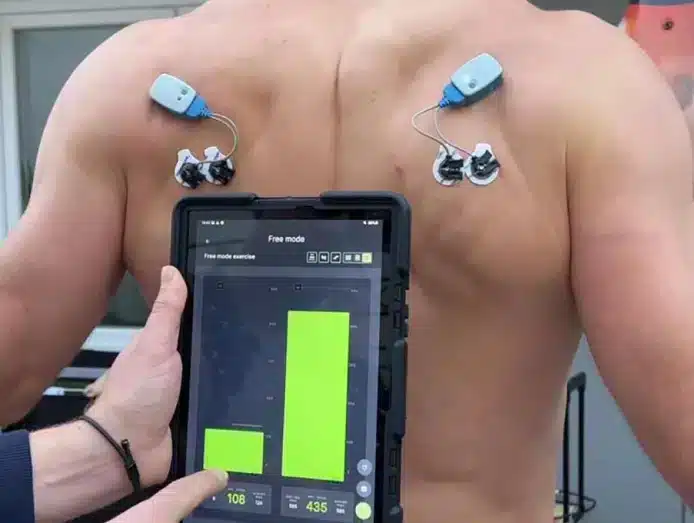
Neuromuscular imbalances – a cumbersome term for a common issue in sports. They often arise due to overcompensation, when the body tries to compensate for weaknesses in certain muscle groups. In case the balance between strain and resilience is disrupted, the risk of injuries, pain, and declines in performance increases. EMG provides real-time insight into which muscle groups are active during an exercise and whether improper compensation by other muscle groups is occurring. EMG mapping creates a comprehensive overview of the surrounding musculature, allowing for targeted monitoring of an exercise’s effectiveness on the intended muscle.
Identify Weak Spots and target them specifically
A real-world example: Stephan Pütz, one of Germany’s top MMA fighters, suffered a shoulder injury after a severe motorcycle accident. EMG analyses revealed that the activity of his infraspinatus muscle on the affected side reached less than half of his individual reference value, despite not being directly impacted by his injury (Tossy 3 AC joint injury). The result: muscle atrophy or, in other words, a decrease in muscle mass. Through targeted biofeedback training, Pütz was able to counteract further muscle loss and integrate specific activation of the infraspinatus muscle into strength exercises, preventing potential compensatory mechanisms. Biofeedback training, comprehensive physiotherapy, and a conscious approach to contributing factors – such as an anti-inflammatory diet, targeted training management, and a positive mindset – enabled Stephan Pütz to return to the octagon just months after his accident and successfully compete without requiring surgery.
Monitoring to Quantify Training Success
Progress in training can not only be felt but also measured. Continuous EMG monitoring of Stephan Pütz showed a significant improvement in his muscle activity. These data help coaches and athletes quantify the success of training and make immediate adjustments when needed.

Picture 3 description
Picture 4 description
Biofeedback Training: An Underestimated Training Method
EMG biofeedback training may sound technical, but it is highly effective. Athletes receive direct visual feedback on their muscle activity, allowing them to optimize their movements and techniques. The trainer’s “cueing” becomes verifiable: Is the athlete executing the movement as intended? Is the exercise targeting the right muscle? By shifting the focus externally, body awareness and self-efficacy improve, which should then be integrated into everyday training using the newly learned activation patterns.
“I can see how I can activate certain muscle groups more effectively, and I feel like it really helps me, especially with highly specialized training, such as sprinting.” Joshua Abouaku, Hurdler, TeamD Tokyo 2020 and Paris 2024. Beyond the training field, EMG is also a valuable tool in sports medicine. Dr. Christoph Lambert, team doctor for the German Judo National Team and the Olympic Surfing Team, utilizes EMG both preventively and in return-to-sport processes to detect imbalances. Studies and reports from professional sports confirm the effectiveness of biofeedback training.
“Especially in pre-season screenings, injury prevention, and return-to-sport scenarios, EMG screenings and EMG biofeedback are crucial tools for our national teams, offering a new level of athlete support.” Dr. Christoph Lambert, Team Doctor for the German Judo and Surfing National Teams.
Conclusion
More and more coaches and physiotherapists in elite sports recognize the value of modern EMG-supported diagnostics and EMG biofeedback training. In both elite and amateur sports, the goal should be to combine the benefits of modern technology with proven concepts. With this approach, athletes’ training can be optimized while at the same time sustainably promoting their health and performance. The future of elite sports lies in this synergy – and the best part: that future starts now.
Das könnte dich auch interessieren


